
Publication of a Research Article Entitled “The Effect of Programmed Hope-Inspiring Training on Hope and Anxiety Among Relatives of Patients Undergoing Mechanical Ventilation: A Quasi-Experimental Study”
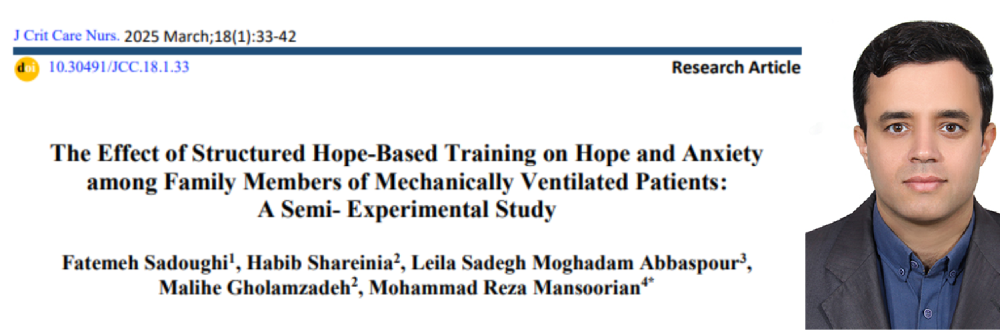
Dr. Habib Shareinia, Assistant Professor at the School of Nursing, Gonabad University of Medical Sciences, along with his colleagues, has published a research article entitled “The Effect of Programmed Hope-Inspiring Training on Hope and Anxiety Among Relatives of Patients Undergoing Mechanical Ventilation: A Quasi-Experimental Study” in the Journal of Critical Care Nursing.
Anxiety is one of the most common psychological responses among families of patients admitted to intensive care units, which can significantly impair their ability to support the patient. Hope, serving as a crucial coping resource, plays a vital role in mitigating anxiety. Therefore, the present study was conducted to investigate the effect of a programmed hope-inspiring training intervention on the hope and anxiety of relatives of mechanically ventilated patients.
In this quasi-experimental study, 60 family members were selected via convenience sampling and assigned to intervention and control groups. The intervention group received structured hope-inspiring training (based on Snyder’s hope therapy protocol) delivered through group sessions, while the control group received routine ward care.
The findings demonstrated that in the intervention group, levels of hope increased, whereas anxiety levels (both state and trait anxiety) decreased. Statistical results revealed a significant difference in levels of hope and latent (trait) anxiety between the two groups following the intervention.
In conclusion, programmed hope-inspiring training effectively reduces anxiety and enhances hope among relatives of patients undergoing mechanical ventilation, and it can be considered as a complementary approach in nursing care.